



Myth-busting misconceptions: Lifting
Mythbusting misconceptions: Manual Material Handling
Are you an employee that has to do manual labor such as lifting? There may be some points about lifting that you believe to be facts, but they turn out to be myths. In this blog post, we will debunk common manual material handling myths and showcase the truth so you can be more informed.
Myth #1: The maximum lifting limit is always 50 pounds.
This myth came from three major assumptions. The first assumption is that only one lift is performed in an 8 hour period, and the second assumption is that the lift occurs at waist height, with loads lifted close to the body. Lastly, the third assumption is that the item being lifted is a compact box with handles, and the weight inside the box is evenly distributed. So, what’s the truth? As lifting frequency, vertical lifting range, or horizontal distance to load increases, or as coupling grip decreases, the maximum an individual can safely handle is less than 50 pounds. What is considered safe is dependent on many factors. If you lift maximum weights once per day, this can help avoid employee injury risk.
Myth #2: Two individuals can lift twice as much as one individual
Fact: Two individuals can lift approximately twice minus 7% of the maximum weight one individual can handle. While one may think two person lifting is beneficial for heavy loads, the truth is that this is not ideal. When using two-person lifting, it is important to maintain clear communication before and during lifting, and using proper lifting techniques to help offset the effects of different employee statures. Proper lifting techniques also help offset different strength levels and unevenly distributed loads.

Myth #3: Everyone knows what proper lifting technique is
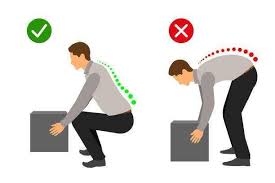
Ever heard the expression, “Lift with your legs, not your back?” This expression is true, but it can be hard to figure out what is meant when we say this. The muscles in our legs are stronger and larger than our back muscles, and our leg muscles were designed for brunt-like tasks such as lifting. Our back muscles are not meant for lifting, but are built more for posture support. When teaching proper lifting technique, employees need to know the basic principles of lifting, such as how to brace the core properly and how to crouch or squat properly. The training should be relevant to the job and include specific handling tasks using actual equipment from the company.
Myth #4: There is no difference between pushing and pulling.
Fact: From a force perspective, pushing and pulling uses the same force to overcome friction and move items. However, internal force experienced by the body is different, and it is better to push rather than pull whenever possible. While pushing, we can use both hands while continuing to walk forward whereas pulling with both hands causes us to walk backwards. If we want to walk forward while pulling, we have to use one hand which then leads to an increased risk of injury to the shoulder joint of the pulling arm. This also creates a twist in the spine, leading to back pain.
If you are an employee that has lifting tasks, ensure you are following proper lifting techniques for your specific job. Need more effective training? Contact Ergo in Motion for presentations and start making your workplace or home office more ergonomically friendly today!