



Back Pain from Carrying Groceries? 5 Physical Therapist Tips to Protect Your Spine
Back Pain from Carrying Groceries? 5 Physical Therapist Tips to Protect Your Spine
You know the moment.
Six grocery bags hanging off your fingers, forearms burning, halfway across the driveway — and you've already decided you're not making a second trip.
That decision is where a lot of back pain starts.
As a physical therapist, I can tell you it's rarely one dramatic lift that causes the problem. It's repeated exposure to poor mechanics under fatigue. Carrying groceries just happens to be one of the most common ways people unknowingly overload their lower back — and one of the easiest to fix.
I’ve treated many desk workers who swear they “did nothing” to hurt their back. Then, after a little digging, we trace it back to something simple: lifting bags out of the car after a long workday, twisting with a laundry basket, or carrying too much at once because making two trips felt unacceptable.
Sound familiar?
Why Carrying Groceries Is Harder on Your Spine Than You'd Think
Your spine is built to handle load. The problem isn't the weight — it's the position.
When most people carry groceries, three things go wrong at the same time:
The load drifts away from the body.
The weight becomes uneven from side to side.
Fatigue erodes posture and muscle control.
Each factor adds stress on its own. Combined, they compound quickly.
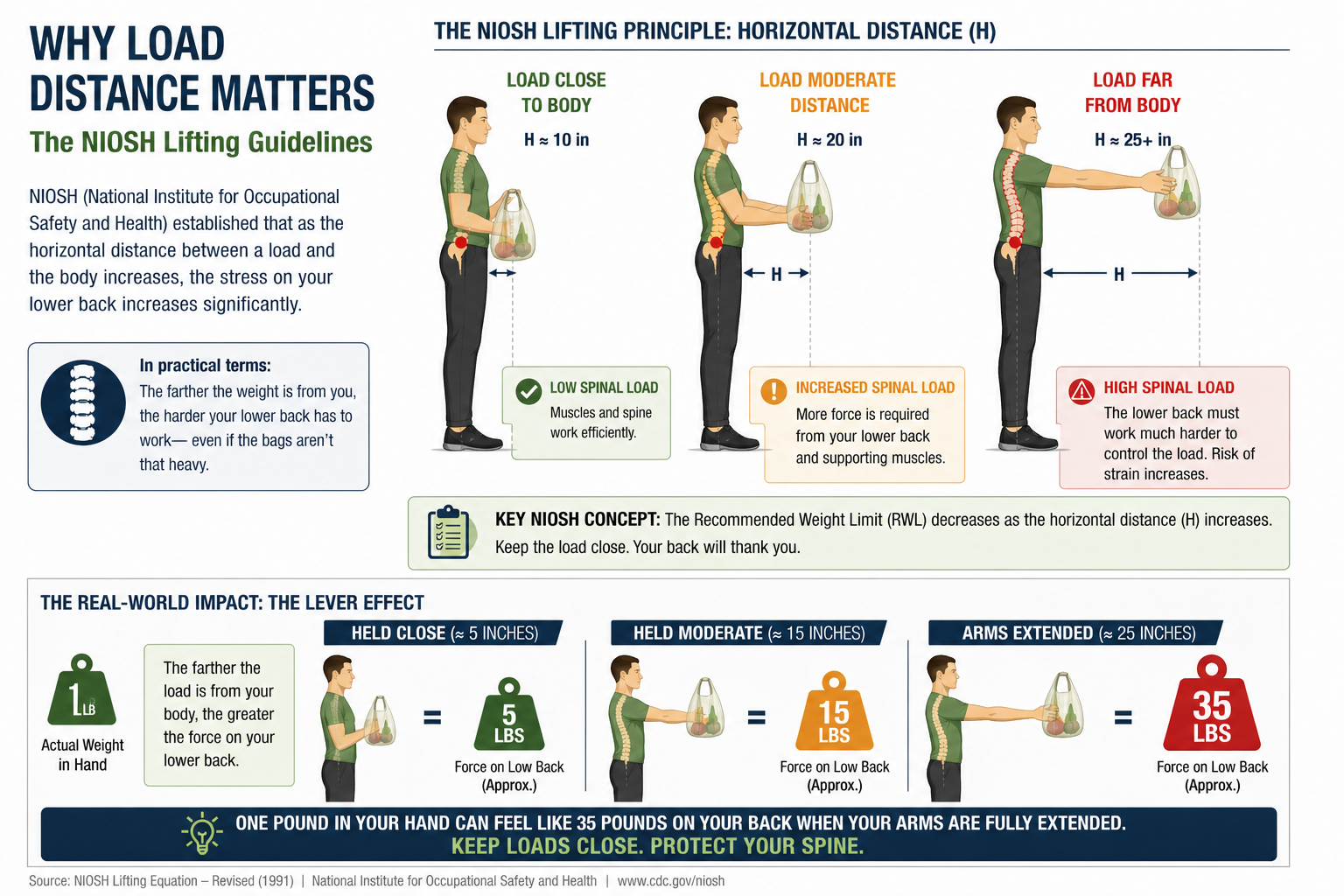
From a biomechanics standpoint, load distance matters more than most people realize. NIOSH lifting guidelines establish that as the distance between a load and the body increases, the stress placed on the spine and supporting structures increases significantly. To put that in practical terms: a bag that weighs five pounds held close to your body can feel like 35 pounds when your arms are fully extended. The weight didn't change — the leverage did.
Now layer that on top of a body that's been sitting at a desk for eight hours, and the risk goes up further. More on that in a moment.
How to Carry Groceries Without Straining Your Back
1. Keep the Load Close
This is the most impactful adjustment you can make, and it costs nothing.
Ergonomists recommend keeping loads as close to the body as possible during lifting and carrying tasks. Rather than letting bags swing at arm's length, pull them in toward your torso, keep your elbows slightly bent, and maintain active control of the load. This reduces the lever effect on your spine almost immediately.
It feels a little awkward at first. Do it anyway.
2. Distribute Weight Evenly
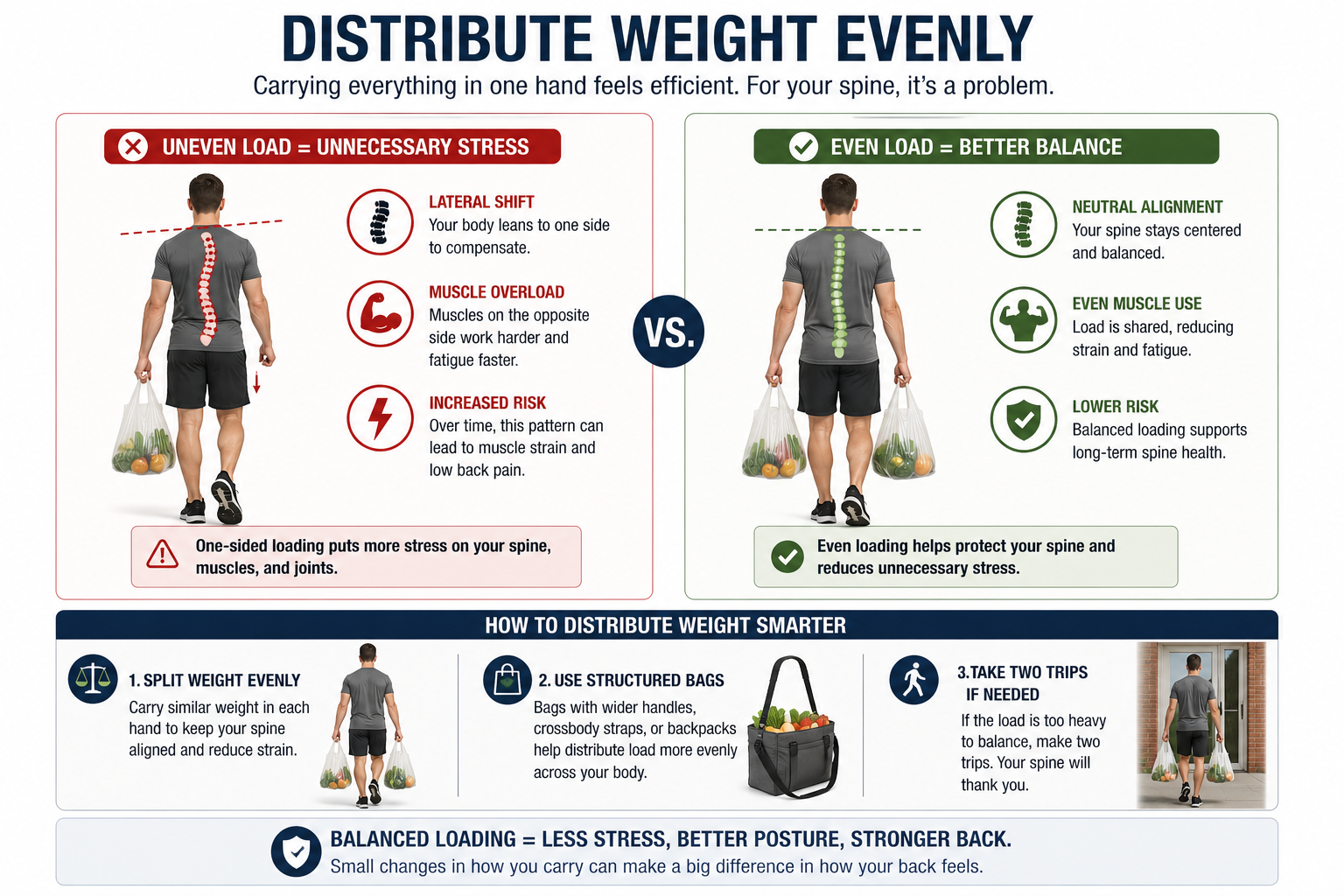
Carrying everything in one hand feels efficient. For your spine, it's a problem.
When weight is heavier on one side, your body compensates by shifting laterally — overloading the muscles on the opposite side and accelerating fatigue. Over time, this pattern contributes to the kind of nagging low back pain that doesn't trace back to any single event.
Split weight evenly between both hands when you can. If you're managing more bags than that allows, make two trips or use a structured bag with a shoulder strap. Balanced loading distributes stress more evenly across the spine and surrounding musculature.
3. Use a Hip Hinge — Not Just Your Legs
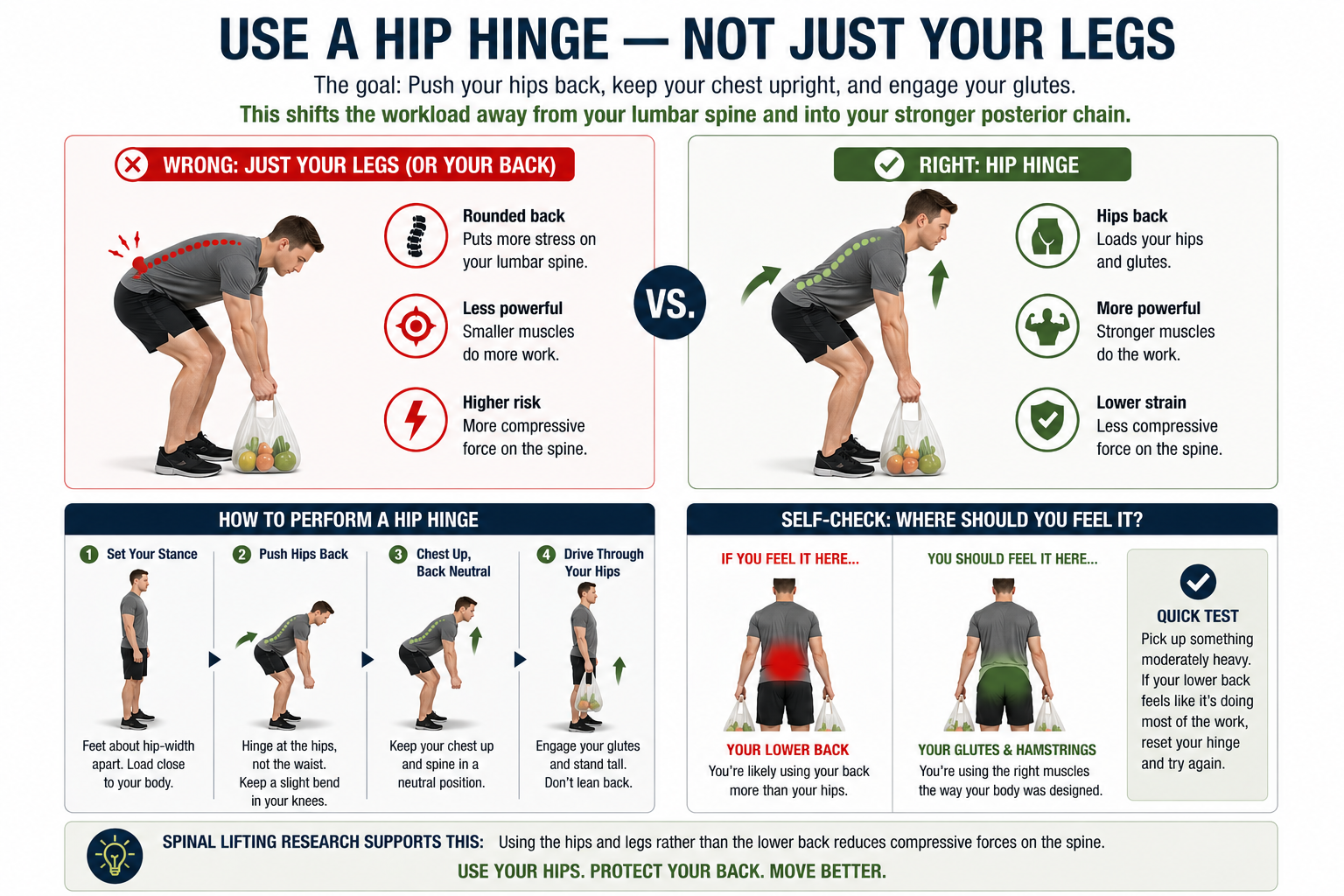
"Lift with your legs" is advice most people have heard. It's also incomplete.
The real goal is a hip hinge: pushing your hips back, keeping your chest upright, and engaging your glutes to drive the movement. This shifts the workload away from your lumbar spine and into the larger, more powerful muscle groups of your posterior chain — exactly where it belongs. Spinal lifting studies support this directly, noting that using the hips and legs rather than the lower back reduces compressive forces on the spine, and your body will tell you when you're doing it wrong.
A simple self-check: if your lower back feels like it's doing most of the work when you pick something up, it probably is.
4. Pivot Instead of Twist
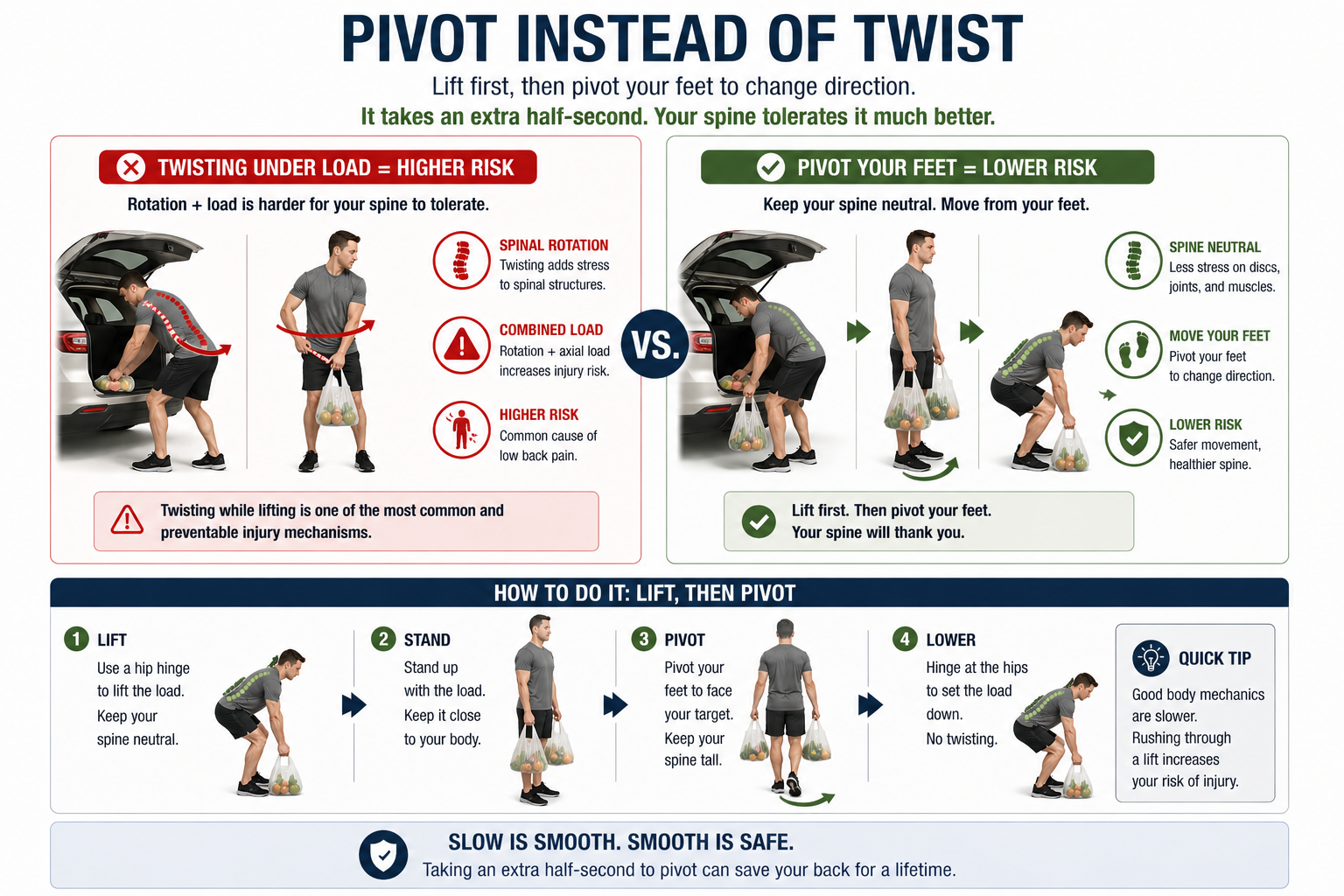
Twisting under load is one of the most common and preventable injury mechanisms I see, especially when stress is applied across multiple planes of motion simultaneously.
The classic scenario is lifting groceries out of a trunk, then twisting to set them on the ground. That combination of rotation and axial load is harder for your spine to tolerate than either movement alone.
The fix is simple: lift first, then pivot your feet to change direction. It takes an extra half-second. Your spine tolerates it much better. Remember, good body mechanics are typically slower and take more time than poor ones, that is why I see more patients consistently get injured when “rushing” through a lift.
5. Respect Fatigue
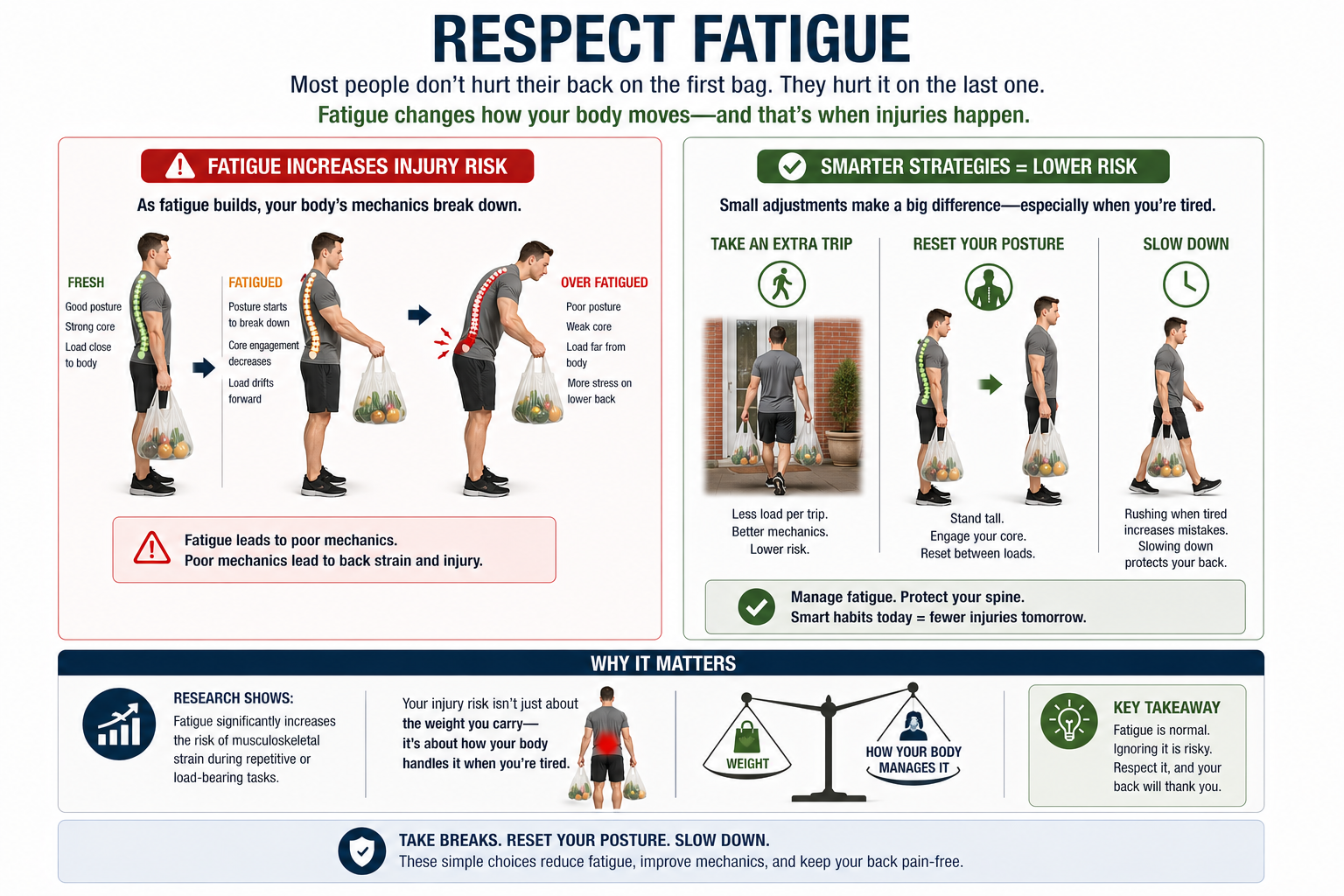
Most people don't hurt their back on the first bag. They hurt it on the last one.
As fatigue accumulates, posture breaks down, core engagement decreases, and load shifts progressively onto the lower back. Research studies confirm that fatigue significantly increases the risk of musculoskeletal strain during repetitive or load-bearing tasks — and grocery runs, especially at the end of a long day, qualify.
This means taking an extra trip matters. Resetting your posture between loads matters. Slowing down when you're tired matters. Your injury risk has less to do with the weight you're carrying and more to do with how your body is managing it.
Why Desk Workers Are More Vulnerable
Here's something most people miss: if you sit most of the day, your body is already at a disadvantage before you touch a single bag.
Prolonged sitting contributes to tight hip flexors, reduced glute activation, and lower baseline core engagement. So when you go to lift groceries, your body can't recruit the muscles it's supposed to use — and it defaults to the lower back instead. That's why so many desk workers experience pain from tasks that don't seem particularly demanding.
It's not just about the groceries. It's about what your body was prepared to handle going into it.
Before unloading the car, stand tall, squeeze your glutes a few times, take two slow breaths, and reset your posture. It sounds simple, but it helps your body shift out of “desk mode.”
The Bottom Line
Back pain from carrying groceries isn't usually the result of one bad movement. It's the result of repeated patterns of loading too far from the body, weight being unevenly distributed, and ignoring fatigue all layered on top of a body that spent the day sitting at a desk.
Small mechanical adjustments make a real difference. Keeping the load close, using your hips, distributing weight evenly, and respecting fatigue aren't complicated strategies. They're the same principles used in workplace injury prevention, and they apply just as much in your driveway as they do in a warehouse.
If everyday tasks like carrying groceries, lifting laundry, or getting out of your chair are causing discomfort, the task usually isn't the problem — your movement patterns are. That's where the real opportunity is.
At Ergo in Motion, we help people identify those patterns and build practical solutions that reduce pain and support long-term function. If you're ready to stop guessing and start moving better, an ergonomic assessment is the place to start.
Learn more about ergonomic assessments at Ergo in Motion
Frequently Asked Questions About Back Pain from Carrying Groceries
Why does my back hurt after carrying groceries?
Your back may hurt after carrying groceries because the bags create extra strain on your spine, shoulders, and core muscles. The farther the bags hang away from your body, the more force your back has to manage. Carrying uneven loads, twisting while lifting, or bending from the waist can also increase stress on your lower back.
Is it better to carry one heavy bag or two lighter bags?
It is usually better to carry two lighter bags with the weight evenly balanced on both sides of your body. Carrying one heavy bag on one side can cause your body to lean, twist, or compensate, which may increase back, hip, shoulder, or neck strain. When possible, split the weight into smaller loads and keep the bags close to your body.
How should I lift groceries out of the trunk?
To lift groceries out of the trunk, stand close to the bags, bend at your hips and knees, and keep your back in a neutral position. Avoid reaching far into the trunk with your arms fully extended. Pull the bags closer first, tighten your core gently, lift with your legs, and turn by moving your feet instead of twisting your back.
When should I see a physical therapist for back pain?
You should consider seeing a physical therapist if your back pain lasts more than a few days, keeps coming back, limits daily activities, or gets worse with lifting, carrying, sitting, or standing. You should seek medical care sooner if you have pain going down your leg, numbness, weakness, changes in balance, or pain after a fall or injury.